Trenchless Sewer Repair Cost Guide
Is Trenchless Sewer Repair Expensive?
Is Trenchless Sewer Repair Expensive? A Deep Homeowner Guide to Sewer Line Repair Costs in the United States
When a sewer line starts failing, the first question most homeowners ask is not technical. It is financial. How much is this going to cost? The second question usually comes right behind it: is trenchless sewer repair expensive compared to traditional digging? The honest answer is that trenchless sewer repair can be a major investment, but it is not always the most expensive path when the full project is understood. The cost conversation has to include more than the pipe itself. It has to include excavation, restoration, access, permitting, sewer depth, pipe material, landscaping, driveways, sidewalks, patios, interior slabs, and the long-term value of repairing underground infrastructure with less destruction.
This is where many sewer repair searches become confusing. A homeowner may search for sewer line replacement cost, trenchless sewer repair cost, pipe lining cost, sewer pipe repair near me, cast iron sewer replacement, drain line repair, or pipe bursting cost and find very different numbers. Some sources talk about small repairs. Some talk about full sewer lateral replacement. Some include restoration, while others do not. Some discuss cleaning or drain unclogging, which is not the same as repairing a structurally damaged sewer line. This guide is written to help homeowners understand the difference between surface-level pricing and real project economics.
From a national perspective, trenchless sewer repair is often priced by the linear foot and by the technical difficulty of the job. Broad residential ranges commonly fall between about $80 and $250 per linear foot for pipe lining, while pipe bursting and more involved trenchless replacement work may range from roughly $100 to $350 per linear foot in higher-cost markets. Full projects can land anywhere from several thousand dollars to $30,000 or more depending on the home, region, length of line, depth, pipe material, and access conditions. Those numbers can feel large, but they need to be compared against the real cost of traditional excavation, especially when the sewer line runs under a driveway, patio, mature landscaping, sidewalk, slab, or finished interior space.
Core point: Trenchless sewer repair may look expensive if you compare only the pipe work. It may look much more reasonable when you compare the total cost of fixing the sewer line and restoring the property afterward.
Why the cost question is harder than it looks
Sewer repair pricing is difficult because homeowners are rarely comparing identical scopes. One quote may be for clearing a clog. Another may be for replacing ten feet of pipe. Another may be for lining an entire sewer lateral from the house to the municipal main. Another may involve breaking concrete, cutting asphalt, removing trees, bypassing utilities, or restoring landscaping. Each of those projects belongs in a different cost category.
This is why the phrase sewer repair cost can be misleading. A basic drain clearing service may be a maintenance event. A sewer video inspection may be a diagnostic event. Hydro jetting may restore flow but not repair a broken pipe. A point repair may address one damaged section. Pipe lining may rehabilitate a longer run. Pipe bursting may replace the pipe along the existing path. Excavation may physically remove and replace the line. All of these can be connected to the same homeowner symptom, but they do not carry the same cost, lifespan, or property impact.
A homeowner with one clogged toilet may not need sewer rehabilitation. A homeowner with recurring backups from root intrusion, cracked clay pipe, deteriorated cast iron, a collapsed sewer lateral, or major pipe offsets may be facing a much larger infrastructure issue. The cost conversation should begin only after the actual condition of the pipe is understood.
What trenchless sewer repair actually means
Trenchless sewer repair refers to methods that reduce the need for long open trenches across the property. Instead of digging up the full path of the sewer line, trenchless methods typically use access points, cleanouts, small pits, or the existing pipe pathway to rehabilitate or replace the line with less surface disruption.
Cured-In-Place Pipe lining
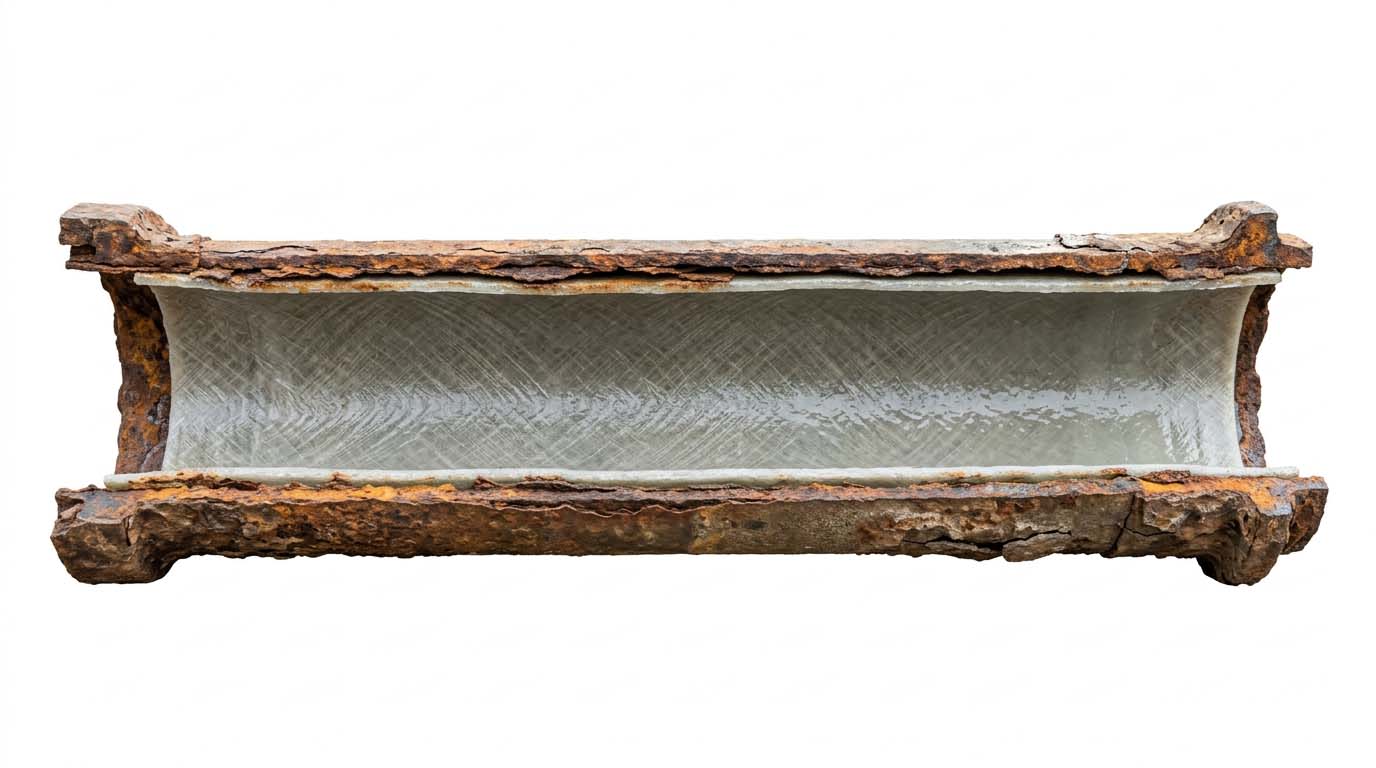
CIPP lining uses a resin-saturated liner that is inserted into the existing pipe and cured to form a new pipe wall inside the old one. It is often considered when the host pipe is still suitable enough to support rehabilitation.
Pipe bursting
Pipe bursting breaks the old pipe outward while pulling a new pipe into the same general path. This method is often considered when replacement is needed but full-length excavation may be avoidable.
Point repair
Point repair focuses on a specific damaged area rather than the entire sewer line. It may be relevant when the rest of the line remains in serviceable condition.
Cleaning and preparation
Many trenchless jobs require cleaning, root removal, descaling, or camera verification before repair work can begin. Prep work can materially affect the final cost.
Trenchless does not mean no digging at all. It means less digging in many cases. Some access excavation may still be needed depending on cleanouts, pipe layout, depth, and connection points.
National sewer repair cost ranges homeowners should understand
National averages are useful only when they are treated as ranges, not guarantees. Sewer repair costs vary by region, property type, line length, pipe depth, pipe diameter, material condition, and whether the project includes restoration. Still, broad pricing bands help homeowners frame the conversation before reviewing specific estimates.
| Repair Category | Typical Residential Range | Common Per-Foot Range | What It Usually Means |
|---|---|---|---|
| Sewer camera inspection | $250–$800+ | Not usually per foot | Diagnostic review of pipe condition and location |
| Drain cleaning or snaking | $200–$900+ | Not usually per foot | Flow restoration, not structural repair |
| Hydro jetting | $500–$2,000+ | Variable | High-pressure cleaning for debris, roots, grease, or scale |
| CIPP pipe lining | $4,000–$20,000+ | $80–$250+ | Rehabilitates existing pipe interior when suitable |
| Pipe bursting | $8,000–$30,000+ | $100–$350+ | Replaces pipe along existing path with limited excavation |
| Traditional excavation | $6,000–$35,000+ | $50–$250+ before restoration | Digging to expose and replace the damaged line |
The important detail is that excavation pricing is often incomplete unless restoration is included. A traditional dig may appear cheaper if the quote only covers trenching and pipe replacement. Once concrete, asphalt, pavers, sod, irrigation, trees, retaining walls, and interior finishes are added, the total project can change dramatically.
Regional cost differences across the United States
Trenchless sewer repair cost is not the same everywhere. Labor rates, climate, municipal code, pipe age, infrastructure density, soil conditions, and local demand all influence pricing. The same 50-foot sewer line repair may cost very different amounts in rural Ohio, suburban Florida, downtown Boston, coastal California, or a dense New York neighborhood.
Northeast
The Northeast often has some of the highest sewer repair costs in the country. Older homes, clay and cast iron systems, deep laterals, dense streets, union labor markets, traffic control, and strict municipal requirements can all increase cost. In major metro areas, trenchless sewer repair may commonly fall in the $120 to $350 or higher per-foot range depending on access and project scope. Traditional excavation may also become costly because restoration in dense areas can involve sidewalks, roadways, stoops, basement slabs, and municipal right-of-way work.
Southeast
The Southeast includes a wide mix of cost conditions. Florida, Georgia, the Carolinas, Tennessee, and surrounding markets often see trenchless pipe lining and sewer repair pricing from roughly $80 to $240 per foot, with higher numbers in complex urban or slab-related projects. Florida is especially known for cast iron drain failure in older homes, where interior slab access and descaling can drive up cost. In many Southeast properties, trenchless methods may be attractive because the sewer or drain line runs under finished floors, driveways, patios, pools, or landscaping.
Midwest
Midwest pricing often lands in a moderate national range, but freeze-thaw cycles, clay soils, root intrusion, and older municipal infrastructure still create complex sewer repair situations. Per-foot trenchless costs may commonly range from $75 to $220, though major cities and deeper lines may exceed those numbers. Excavation may appear more accessible in some suburban settings, but restoration can still become expensive when lines cross driveways, sidewalks, mature trees, or public right-of-way.
Southwest
Southwestern markets may involve expansive soils, long sewer laterals, hard ground conditions, and growing municipal infrastructure demands. Trenchless sewer repair may commonly range from about $85 to $250 per foot, depending on labor, pipe depth, and access. In desert and semi-arid regions, landscaping may seem less costly than in greener markets, but hardscapes, decorative concrete, patios, and utility conflicts can still make excavation expensive.
West Coast
The West Coast, particularly California, Oregon, Washington, and major coastal metros, can see some of the highest trenchless sewer repair pricing in the United States. Labor rates, permitting, environmental requirements, seismic considerations, steep lots, retaining walls, hillside access, and dense property layouts can push costs above $150 to $350 per foot in some projects. However, because excavation and restoration can also be extremely expensive in these markets, trenchless repair may still be a strong value when conditions support it.
Why trenchless repair can look expensive upfront
Trenchless sewer repair can feel expensive because it is not just a labor-and-pipe job. It often involves specialized equipment, trained crews, resin systems, curing technology, sewer cameras, locators, cutters, hydro jetters, descaling equipment, bypass planning, and municipal coordination. In many cases, the cost reflects a complete rehabilitation process rather than a simple pipe swap.
Common trenchless cost drivers include:
- Length of the sewer line being repaired
- Diameter of the pipe
- Depth of the pipe
- Number of bends, transitions, or offsets
- Severity of root intrusion
- Amount of scale or corrosion
- Whether cleaning or descaling is required
- Whether access pits must be created
- Whether branch lines must be reinstated
- Municipal permit and inspection requirements
- Traffic control or right-of-way restrictions
- Local labor and material pricing
A homeowner looking only at the final number may see a high cost. A homeowner looking at the entire project may see that the price includes diagnostics, preparation, pipe rehabilitation, specialized installation, and reduced surface destruction.
The biggest hidden cost: restoration after excavation
Traditional excavation may still be the right choice in many situations, especially when the pipe has collapsed, access is simple, the affected section is short, or trenchless rehabilitation is not technically appropriate. The problem is not excavation itself. The problem is comparing excavation to trenchless without counting what excavation destroys.
A traditional sewer replacement that looks like a $9,000 pipe job can become a $20,000 or $30,000 property project once restoration is added. This is especially true when a sewer line crosses a finished driveway, an expensive patio, mature landscaping, or an interior slab. In these cases, trenchless sewer repair may carry a higher direct repair price but lower total damage cost.
Example comparison: pipe repair cost versus total project cost
The following example is not a quote. It is a way to understand how total project economics can change the conversation.
| Cost Item | Trenchless Scenario | Excavation Scenario |
|---|---|---|
| Pipe repair or replacement | $13,000 | $9,500 |
| Driveway disruption | Minimal or limited | $5,000–$12,000+ |
| Landscape restoration | Minimal or limited | $2,000–$8,000+ |
| Project disruption | Lower in many cases | Higher in many cases |
| Possible total | $13,000–$16,000 | $16,500–$30,000+ |
This is why homeowners should avoid comparing one number against another without asking what is included. A lower excavation price may not include putting the property back together.
Pipe lining cost versus pipe bursting cost
Pipe lining and pipe bursting are often grouped together under trenchless sewer repair, but they are not the same service.
CIPP pipe lining
Pipe lining is often less disruptive when the existing pipe is structurally suitable. It creates a new interior pipe wall inside the old pipe. This can be effective for cracks, root intrusion points, corrosion, and certain joint defects, but it depends on the host pipe not being too collapsed, deformed, or misaligned.
Pipe bursting
Pipe bursting is often closer to replacement. The old pipe is broken apart while a new pipe is pulled into place. It may be useful when the existing pipe is too damaged for lining but the path can still be used. Pipe bursting often requires access pits and may cost more than lining, but it can provide a more complete replacement approach.
In simple terms, lining is often rehabilitation, while bursting is often replacement. The cheaper choice is not automatically the better choice. The right choice depends on the pipe condition, material, diameter, depth, bends, service connections, and long-term goals.
How pipe material changes the cost conversation
Pipe material matters because different materials fail in different ways. A sewer camera inspection may show clay, cast iron, PVC, Orangeburg, concrete, or a mix of materials. Each one changes the repair conversation.
Cast iron
Cast iron may suffer from internal scaling, corrosion, channel loss, and thinning. Descaling may be required before lining, and severely deteriorated sections may not be good candidates for simple rehabilitation.
Clay
Clay pipe often fails at joints and is highly vulnerable to root intrusion. Repeated cleaning may restore flow temporarily while leaving structural entry points unchanged.
Orangeburg
Orangeburg pipe can deform, blister, or collapse. Some systems may not be suitable for lining depending on condition.
PVC
PVC may have fewer age-related corrosion issues but can still suffer from bellies, improper slope, crushed sections, or poor installation.
Why camera inspection should come before serious pricing decisions
A sewer video inspection is one of the most important cost-control steps in the entire process. Without video evidence, the repair discussion may rely too heavily on symptoms. A recurring backup could be roots. It could be a belly. It could be scale. It could be a collapsed pipe. It could be a bad joint. Each cause may have a different cost and repair method.
The inspection helps identify:
- Where the defect is located
- How much of the line is affected
- Whether the pipe is cracked, offset, collapsed, scaled, or root-filled
- Whether the pipe has standing water
- Whether the host pipe may support lining
- Whether excavation or bursting may be more realistic
- Whether cleaning, descaling, or prep work is needed first
For homeowners, the inspection is not just a diagnostic tool. It is a financial planning tool.
Drain cleaning versus sewer repair: why this distinction matters
Many homeowners search for drain repair cost when they are actually dealing with sewer line failure. Others search for sewer repair when the issue may only require cleaning. The distinction is important because cleaning and repair belong in different cost categories.
Drain cleaning, snaking, and hydro jetting may restore flow. These services may be appropriate for grease, debris, soft blockages, minor roots, or maintenance. But if the pipe has structural cracks, severe offsets, corrosion, collapse, or repeated root intrusion through failed joints, cleaning may only buy time. It may not solve the underlying infrastructure problem.
This is why a homeowner who has paid for repeated drain cleaning visits may eventually face a larger sewer repair estimate. The earlier services were addressing symptoms. The later estimate may be addressing the cause.
Insurance and trenchless sewer repair
Homeowners often ask whether insurance covers trenchless sewer repair. The answer depends heavily on the policy, cause of damage, endorsements, and exclusions. Many standard homeowner policies exclude age-related deterioration, corrosion, root intrusion, or wear and tear. Some policies include or allow service line endorsements that may provide coverage for certain underground utility failures.
Homeowners should review:
- Whether a service line endorsement exists
- Whether the failure was sudden or gradual
- Whether roots, corrosion, or age-related wear are excluded
- Whether excavation and restoration are covered separately
- Whether municipal connection work is included
Insurance should be verified directly with the carrier. It should not be assumed based on general online cost articles.
Warranties and long-term value
Trenchless sewer repair is often discussed as a long-term infrastructure investment. Many lining and replacement systems are marketed with long service life expectations, but warranty terms vary widely. A homeowner should evaluate not just the length of a warranty, but what it actually covers.
Important warranty questions include:
- Is the warranty transferable to a future buyer?
- Does it cover labor as well as material?
- Are roots, ground movement, or abuse excluded?
- Are maintenance requirements specified?
- Does the warranty apply to the full line or only the repaired section?
A long warranty may be valuable, but only if the terms are clear and the repair method is appropriate for the pipe condition.
Financing and budgeting for major sewer repair
Sewer line failure is rarely a planned expense. Unlike a kitchen remodel or landscape upgrade, sewer repair often becomes urgent because wastewater movement affects basic home functionality. Financing can make a large sewer project more manageable, but it should be approached carefully.
Homeowners should compare:
- Cash price versus financed price
- Interest rate and repayment terms
- Whether the work is urgent or can be planned
- Whether temporary cleaning is buying time or delaying the inevitable
- Whether restoration costs are included in the financed amount
Financing does not make the repair cheaper. It changes how the cost is paid. The underlying project scope still needs to be understood clearly.
When trenchless sewer repair may be the better economic choice
Trenchless repair may offer stronger total value when the pipe path crosses expensive or difficult-to-restore surfaces. This is especially common when the sewer line runs under:
- Concrete driveways
- Asphalt driveways
- Paver patios
- Pool decks
- Finished basements
- Interior slab floors
- Mature landscaping
- Sidewalks
- Municipal streets
- Retaining walls
In these situations, the cost of avoiding destruction may be just as important as the cost of repairing the pipe.
When excavation may still be necessary
Trenchless sewer repair is not magic, and it is not suitable for every pipe. Severe collapse, major deformation, extreme offsets, poor access, bad slope, or incompatible pipe conditions may require excavation. In some cases, a short dig repair is more practical and economical than a full trenchless system.
Excavation may be more likely when:
- The pipe has fully collapsed
- The line has lost proper grade
- The defect is shallow and easy to access
- The damaged area is very short
- The host pipe cannot support lining
- Pipe bursting is blocked by site constraints
- Municipal code requires open replacement
The goal should not be to force trenchless into every situation. The goal should be to choose the method that fits the actual pipe condition and total property economics.
Common myths about trenchless sewer repair cost
Myth: Trenchless is always more expensive
Trenchless may cost more upfront in some cases, but total cost may be lower when excavation restoration is included.
Myth: Excavation is always cheaper
Excavation can be cost-effective when access is simple, but it can become expensive when property restoration is significant.
Myth: Every pipe can be lined
Pipe lining depends on host pipe suitability. Camera inspection and preparation are essential.
Myth: Hydro jetting is the same as repair
Hydro jetting cleans the pipe. It does not rebuild collapsed, cracked, or severely deteriorated structure.
Myth: Cost per foot tells the whole story
Per-foot pricing does not always include access, prep, permits, reinstatements, or restoration.
Myth: The lowest quote is automatically best
A lower quote may exclude major scope items or may not solve the underlying failure.
Questions homeowners should ask before approving sewer repair
What does the sewer camera footage show?
Ask to see the actual defect, not just hear a verbal description of the problem.
What exact section is being repaired?
Clarify whether the project covers a spot repair, partial line, full lateral, or interior drain system.
Why is this method being recommended?
The repair method should match the condition shown in the inspection.
What is excluded from the price?
Ask about permits, cleaning, descaling, restoration, landscaping, and municipal fees.
What happens if only part of the line is repaired?
Partial repairs may make sense, but homeowners should understand the remaining system condition.
How to think about expensive versus valuable
Expensive and valuable are not the same thing. A sewer repair can be expensive and still be the most reasonable long-term option. It can also be expensive and poorly matched to the problem. The difference comes down to evidence, scope, and total impact.
A valuable sewer repair should do more than make the immediate symptom disappear. It should address the actual defect, reduce the risk of repeated failures, preserve the property where possible, and provide a clear understanding of what was repaired. If a trenchless method achieves those goals while avoiding major destruction, the higher direct cost may be justified. If it does not match the pipe condition, the cost may not make sense.
Final answer: is trenchless sewer repair expensive?
Yes, trenchless sewer repair can be expensive. It is often a serious infrastructure investment, not a minor plumbing service. Full residential trenchless projects can cost thousands to tens of thousands of dollars depending on the property and region.
But the better question is whether trenchless sewer repair is expensive compared to the true cost of excavation. Once driveways, landscaping, patios, interior slabs, permitting, downtime, and restoration are included, trenchless methods may offer strong total value in many real-world situations.
For homeowners, the smartest path is to avoid judging the project only by the first number on a quote. Start with sewer video inspection. Understand the pipe condition. Compare methods based on the actual defect. Ask what is included and excluded. Consider the restoration impact. Then evaluate whether trenchless sewer repair is not just affordable, but appropriate.
Trenchless sewer repair is not always the cheapest option. It is not always the right option. But when conditions support it, it may be one of the most practical ways to solve a serious sewer line problem while reducing property destruction and long-term disruption.
Research sewer repair costs before making a major decision
Lining Pro helps homeowners understand trenchless sewer repair, pipe lining, pipe bursting, sewer replacement, drain repair, and the questions to ask before choosing a repair path.
Learn how trenchless sewer repair works Compare sewer repair options