Lining Pro.com Technical Brief
Plain-English Summary of NASSCO PACPTM Pipe Condition Grading
NASSCO Pipe Condition Grading Guide
Important source notice: NASSCO is the official source for PACPTM, LACPTM, MACPTM, condition coding, condition grading, certified training, certified professionals, certified software information, and related assessment standards. Readers should use NASSCO’s official website, official publications, official training materials, certified professionals, and certified software resources as the controlling references.
The information below is Lining Pro.com’s plain-language summary based on our understanding of publicly available NASSCO resources and common industry use of PACPTM-style sewer inspection reporting. This page is not published by NASSCO, is not endorsed by NASSCO, and should not be treated as official NASSCO instruction, certification material, software guidance, engineering advice, or a replacement for project-specific professional review.
Trademark notice: PACPTM, LACPTM, and MACPTM are trademarks owned by NASSCO, Inc. Any reference to NASSCO, PACPTM, LACPTM, or MACPTM on this page is for identification, education, commentary, and source-reference purposes only. Lining Pro.com does not claim ownership of those marks and does not claim to be affiliated with, sponsored by, approved by, certified by, or endorsed by NASSCO.
Before making inspection, repair, rehabilitation, replacement, asset-management, bidding, hiring, or engineering decisions, users should verify all definitions, grading rules, coding requirements, Quick Rating interpretation, certification requirements, and software requirements directly with NASSCO and qualified professionals.
Official NASSCO resources to review first:
- NASSCO PACPTM / LACPTM / MACPTM program page
- NASSCO assessment overview
- NASSCO PACPTM condition grading system resource
- NASSCO guidance on PACPTM condition grades and their proper application
- NASSCO PACPTM / LACPTM / MACPTM software certification information
- NASSCO certified professionals directory
NASSCO pipe condition grading is one of the main ways sewer professionals turn CCTV inspection footage into structured, usable condition data. Instead of simply saying a pipe “looks bad” or “has roots,” the Pipeline Assessment Certification Program, commonly called PACPTM, gives trained inspectors a standardized way to code observations, assign condition grades, and help owners organize repair, cleaning, lining, replacement, maintenance, or engineering review decisions.
From the Lining Pro.com perspective, condition scoring matters because it helps property owners, municipalities, engineers, and trenchless contractors speak a more consistent language. A sewer line with one isolated severe observation is not the same as a sewer line with repeated severe observations throughout the run. PACPTM-style scoring helps separate minor maintenance concerns from structural problems that may require rehabilitation, replacement, or further professional review.
What NASSCO PACPTM Grading Measures
PACPTM grading is not a casual opinion about a sewer pipe. It is a coded condition assessment system used during CCTV inspection. Observations are identified, coded, measured, located, and graded according to NASSCO’s PACPTM structure. Grades generally range from 1 to 5, where Grade 1 represents a minor condition and Grade 5 represents the most significant defect grade.
The grade is not supposed to be chosen only by instinct or a quick visual reaction. In PACPTM-style reporting, the defect code, modifier, extent, location, percentage, clock position, and other required fields can affect how a condition is recorded and graded through the PACPTM coding structure and certified software. This helps standardize inspection data so different projects, inspectors, engineers, contractors, and asset owners can compare conditions more consistently.
Plain English: PACPTM does not just record what is seen in the pipe. It organizes what is seen into a repeatable scoring system that can support maintenance planning, repair planning, rehabilitation screening, and asset-management decisions.
The Basic 1 Through 5 Grade Interpretation
The following table is a plain-language summary. It should not be used as the official grading rulebook. For actual coding, grading, reporting, certification, software, and project decisions, use official NASSCO materials and qualified professionals certified through NASSCO’s PACPTM program.
| Grade | General Meaning | Typical Interpretation | Planning Impact |
|---|---|---|---|
| Grade 1 | Minor defect | Low severity observation with limited immediate concern. | Usually monitored or addressed during routine maintenance planning. |
| Grade 2 | Minor to moderate defect | Noticeable condition that is not usually a high-priority structural concern by itself. | May be tracked, cleaned, reinspected, or included in future maintenance scheduling. |
| Grade 3 | Moderate defect | Condition deserves attention, especially if repeated, growing, located in a critical area, or combined with other issues. | Often reviewed for monitoring, cleaning, localized repair, or future rehabilitation planning. |
| Grade 4 | Significant defect | Condition may indicate serious deterioration, major obstruction, infiltration, root mass, deformation, or structural concern. | Often moves the pipe into repair, rehabilitation, closer inspection, or engineering review. |
| Grade 5 | Most significant defect | Severe condition that may indicate high failure risk, major wall loss, collapse, severe deformation, gusher infiltration, major blockage, or another serious issue. | Usually treated as a high-priority condition requiring timely review, action, or engineering evaluation. |
Structural vs Operations and Maintenance Scoring
One of the most important parts of PACPTM interpretation is understanding the difference between structural defects and operations and maintenance defects. They are both important, but they do not mean the same thing and they do not always lead to the same repair decision.
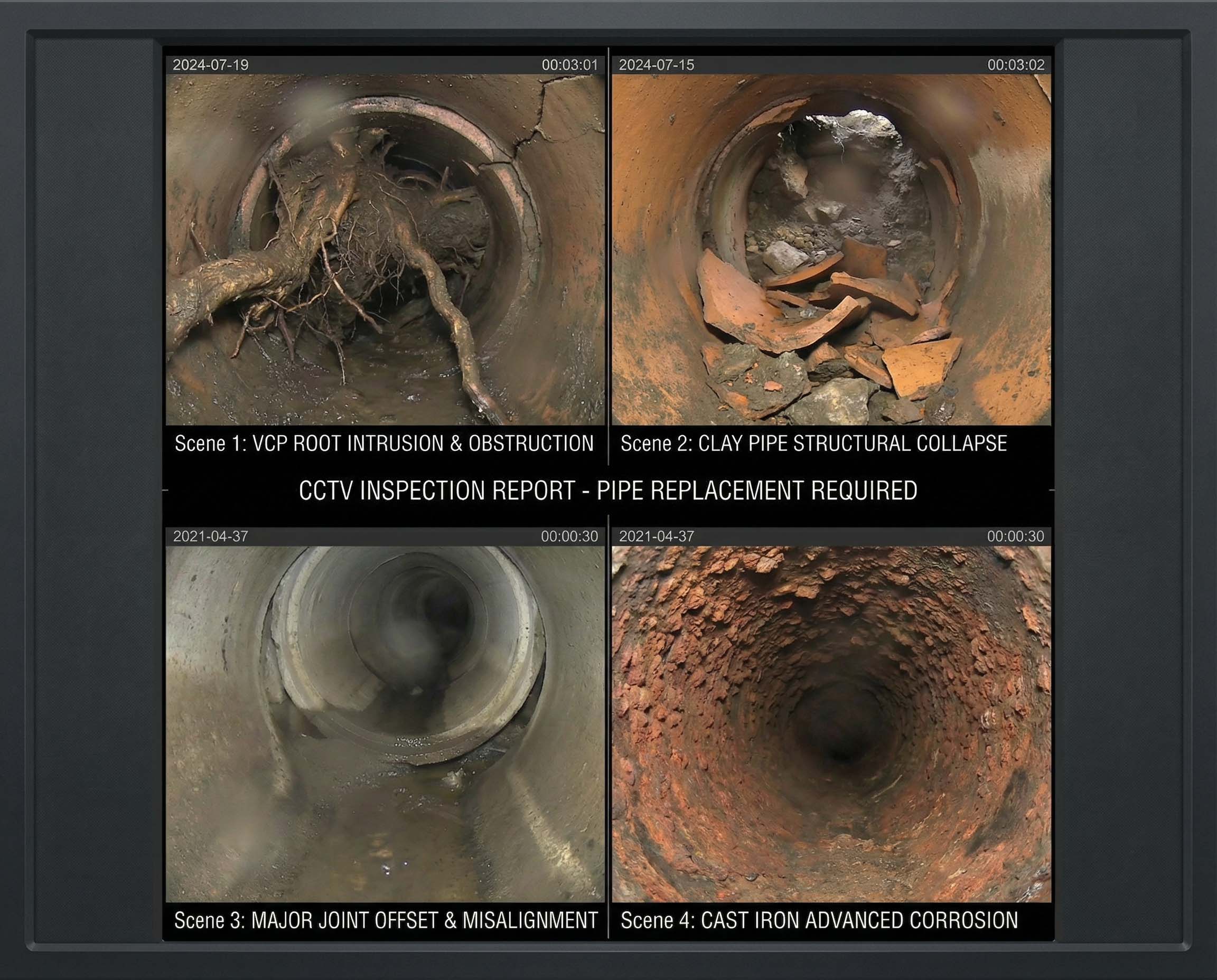
Structural defects relate to the physical condition of the pipe itself. These can include cracks, fractures, broken pipe, deformation, surface damage, missing wall, defective repairs, collapsed sections, or other conditions affecting the pipe body. Operations and maintenance defects relate more to the pipe’s ability to convey flow, such as roots, deposits, grease, infiltration, obstructions, vermin, debris, and other service-related conditions.
| Category | What It Means | Examples | Common Response |
|---|---|---|---|
| Structural | Defects in the pipe wall, pipe shape, joint integrity, or structural condition. | Cracks, fractures, broken pipe, deformation, missing wall, failed repair, collapse. | Repair, lining, point repair, replacement, engineering review, or asset-renewal planning. |
| Operations and Maintenance | Conditions affecting flow, capacity, cleanliness, or serviceability. | Roots, grease, deposits, infiltration, obstacles, vermin, debris. | Cleaning, jetting, root removal, grouting, maintenance scheduling, or further inspection. |
| Overall | A combined view of condition data used to understand the pipe segment’s general severity. | May include structural and O&M factors depending on the reporting method. | Prioritization, budgeting, capital planning, rehabilitation screening, or risk review. |
Important: a pipe can have a serious O&M problem without being structurally failed, and a pipe can have a serious structural defect even if it is still flowing today.
Why One Grade Does Not Tell the Whole Story
A common mistake is looking only at the highest grade and assuming that single number explains the whole pipe. It does not. Condition ratings are influenced by both the severity of the observed defects and the extent or number of observed defects. A pipe with one severe defect may require a localized repair. A pipe with many repeated severe defects may require full-length rehabilitation, replacement planning, or engineering review.
For example, one Grade 4 hole and five Grade 4 holes do not represent the same pipe condition. The severity grade may be the same, but the quantity, spacing, pattern, and location of defects can change the interpretation. That is why proper condition review looks at the defect type, grade, count, location, pattern, pipe material, diameter, flow conditions, access, and consequence of failure.
Understanding PACPTM Quick Rating
PACPTM Quick Rating is a shorthand condition summary that helps communicate severe observed conditions and the number of occurrences. It is useful because it gives a high-level picture of both severity and extent. A Quick Rating can help an owner see whether a pipe has an isolated high-grade defect or multiple repeated severe observations.
PACPTM Quick Rating should not replace official NASSCO guidance, certified software output, engineering judgment, or review by qualified professionals. It is best understood as a screening and prioritization tool, especially when large inspection datasets need to be sorted for cleaning, reinspection, lining, point repair, replacement, or monitoring.
| Quick Rating Concept | What It Helps Show | Why It Matters |
|---|---|---|
| Highest Severity | The worst grade observed in the segment. | Helps identify pipes with potentially serious defects. |
| Number of Occurrences | How often a severity level appears. | Helps distinguish isolated defects from widespread deterioration. |
| Structural Quick Rating | Summarizes structural defect severity and frequency. | Useful for rehabilitation and replacement prioritization. |
| O&M Quick Rating | Summarizes service-related defects such as roots, deposits, and obstructions. | Useful for cleaning, maintenance, and operational planning. |
How Condition Scoring Connects to Real Repair Decisions
Condition scoring does not automatically prescribe one repair method. A Grade 4 or Grade 5 observation does not automatically mean full replacement, and a Grade 2 observation does not automatically mean no action. The score is a decision-support tool. The final recommendation depends on pipe material, depth, access, diameter, defect location, service criticality, flow conditions, surrounding assets, cost, risk, and consequence of failure.
In trenchless sewer repair, PACPTM-style condition grading can help determine whether a pipe is primarily a cleaning problem, a point repair candidate, a CIPP lining candidate, a pipe bursting candidate, a replacement candidate, or a candidate for additional engineering review.
Maintenance Candidate
O&M defects such as deposits, grease, roots, or debris may point toward hydro jetting, chain knocking, root cutting, cleaning, or scheduled maintenance.
Spot Repair Candidate
An isolated high-grade structural defect may be better suited for a localized point repair instead of full-length replacement, depending on access, risk, and pipe condition.
CIPP Lining Candidate
Repeated cracks, joints, roots, infiltration, or corrosion may support full-length lining if the pipe still has enough shape and continuity to receive the liner.
Pipe Bursting Candidate
A line that is too deteriorated for lining but still follows a usable path may be evaluated for pipe bursting where site conditions allow.
Replacement Candidate
Collapsed pipe, severe deformation, major bellies, grade failure, missing sections, or unstable host pipe may require excavation, sectional replacement, or full replacement.
Engineering Review Candidate
Critical pipes, repeated high-grade defects, uncertain failure modes, or high-consequence assets may need engineering interpretation beyond basic scoring.
A Practical Interpretation Framework
This framework is not a NASSCO substitute. It is a practical way for owners, managers, and contractors to think through condition reports after the inspection data has been properly coded and reviewed.
Separate Structural From O&M Defects
First determine whether the pipe problem is primarily structural, operational, or both. Roots and deposits may point toward maintenance, while deformation, missing wall, fractures, and broken pipe point toward structural repair planning.
Look at Severity
Review the highest defect grades. Grade 4 and Grade 5 observations typically deserve closer review, especially when they are structural, repeated, located in critical areas, or tied to service failure.
Review Frequency and Distribution
One defect may suggest a localized repair. Many repeated defects may suggest a full-length rehabilitation strategy. The number, spacing, and pattern of defects can change the repair logic.
Consider Pipe Material, Access, and Consequence
A Grade 3 defect in a shallow, low-consequence line may be managed differently than a Grade 3 defect in a critical sewer main under a major roadway, hospital, school, or commercial facility.
Match the Repair Method to the Failure Pattern
The final repair plan should consider whether the pipe needs cleaning, spot repair, CIPP lining, UV-cured lining, grouting, pipe bursting, replacement, or further engineering evaluation.
Common Misinterpretations of PACPTM Scores
| Misinterpretation | Better Interpretation |
|---|---|
| “The pipe has a Grade 5, so the whole pipe must be replaced.” | A Grade 5 defect is serious, but the repair may be localized or full-length depending on location, count, pipe condition, access, and risk. |
| “The pipe is flowing, so it is fine.” | A pipe can still convey flow while having significant structural deterioration or high-risk defects. |
| “O&M defects are less important.” | O&M defects can cause backups, surcharge, infiltration, capacity problems, cleaning failures, and accelerated deterioration if ignored. |
| “The score alone tells us the repair.” | The score supports decision-making, but repair selection still requires context, footage review, site conditions, access review, and professional judgment. |
| “One inspection is always enough.” | Heavy deposits, grease, roots, poor lighting, standing water, or poor visibility may require cleaning and reinspection before the true condition is known. |
How PACPTM Scoring Helps Trenchless Contractors
For trenchless contractors, PACPTM-style data can help define the repair strategy. If a pipe has repeated cracks, infiltration, root entry, or corrosion but still maintains shape, CIPP lining may be appropriate. If the pipe has an isolated severe defect, a spot repair may be more efficient. If the pipe has heavy deposits but limited structural issues, cleaning and maintenance may come first. If the pipe is collapsed, severely deformed, or has slope problems, replacement or excavation may be required.
This is where condition scoring becomes practical. It helps connect what the camera sees to what the repair team should consider next, while still leaving room for project-specific review.
Conditions That May Support Trenchless Lining
Conditions That May Push Away From Lining
- Fully collapsed pipe
- Major deformation
- Severe belly or grade failure
- Missing pipe sections
- Unstable host pipe after cleaning
- Access conditions that prevent proper installation
Condition Grade vs Risk Score
PACPTM condition grade is not the same thing as total asset risk. Condition grade describes what was observed inside the pipe. Risk also considers consequence of failure. A shallow lateral serving one building may not carry the same consequence as a deep municipal main under a highway, hospital, school, or commercial district.
In asset management, many owners think in terms of likelihood of failure and consequence of failure. PACPTM condition data can help estimate likelihood of failure, but consequence depends on location, depth, service area, environmental sensitivity, traffic impact, emergency access, business interruption, and customer impact.
| Term | Meaning | Example |
|---|---|---|
| Condition Grade | Severity of observed pipe defects. | A fracture, deformation, root mass, or infiltration defect graded from 1 to 5. |
| Likelihood of Failure | How likely the pipe is to fail based on condition and deterioration pattern. | Repeated Grade 4 or Grade 5 structural defects may increase likelihood. |
| Consequence of Failure | How serious the impact would be if the pipe failed. | A sewer under a hospital or major road may carry higher consequence than a low-risk line. |
| Risk | The combined view of likelihood and consequence. | A moderate defect in a high-consequence location may outrank a worse defect in a low-consequence location. |
What Property Owners Should Ask When They See a PACPTM-Style Score
For homeowners, commercial property owners, and facility managers, the score can be useful, but it should come with explanation. If a contractor says a pipe is a Grade 4 or Grade 5, ask what defect was graded, where it is located, how many times it appears, whether the issue is structural or O&M, and what repair options match the condition.
| Question | Why It Matters |
|---|---|
| Is the grade structural or O&M? | Structural defects and maintenance defects usually lead to different repair decisions. |
| What exact defect was coded? | A grade without the underlying defect type can be misleading. |
| How many times does the defect appear? | Frequency helps distinguish isolated repair from full-length rehabilitation planning. |
| Where is the defect located? | A defect under a slab, roadway, building, utility crossing, or critical area may change the repair strategy. |
| Can I see the camera footage? | Scores should be tied to visible evidence, not vague claims. |
| Was the inspection completed after proper cleaning? | Deposits, roots, grease, and debris can hide structural conditions and reduce visibility. |
| Was the report created by a qualified professional? | PACPTM-style reports should be interpreted by people who understand the coding system and its limits. |
| What repair methods fit this condition? | The condition score should connect to a practical repair plan, not a one-size-fits-all sales pitch. |
The Bottom Line
NASSCO PACPTM condition grading gives the sewer industry a structured language for describing pipe defects. The 1 through 5 grading system helps identify severity, while structural and operations and maintenance categories help separate pipe integrity problems from serviceability and cleaning problems.
The score is powerful, but it is not the whole decision. A responsible interpretation looks at defect type, severity, frequency, location, pipe material, access, consequence, footage quality, cleaning status, repair feasibility, and professional judgment. A Grade 5 defect deserves attention, but the right answer may be spot repair, lining, bursting, replacement, or engineering review depending on the full context.
Lining Pro.com helps users browse contractors who understand sewer inspection, trenchless rehabilitation, CIPP lining, cast iron repair, hydro jetting, descaling, pipe bursting, and structural pipe renewal. Customers should always review camera footage, ask how the condition score was interpreted, consult official NASSCO resources where applicable, and do their own independent research before hiring any contractor.
Browse Trenchless Sewer Repair Contractors
Use Lining Pro.com to browse contractors who work with sewer inspection, condition assessment, CIPP lining, cast iron rehabilitation, hydro jetting, pipe bursting, and structural trenchless repair.
Browse Contractors