Aqua Pro Plumbing only

Prefer to call?

Talk to Aqua Pro Plumbing directly — fastest way to get answers.

786-367-9157

Tap to call from your phone

Called from your phone? Tap the green check so Aqua Pro Plumbing and LiningPro know.

Prefer to stay online?

Fill out a quick form — your request goes straight to Aqua Pro Plumbing.

Step 1 of 4 — Your Issue

Custom service page

Culvert rehabilitation in Florida

Large-diameter culvert rehabilitation in Miami and Fort Lauderdale for stormwater pipe repair, lining, joint sealing, flow restoration, and soil loss prevention.

Offered by Aqua Pro Plumbing in Florida

5.0 · 5 reviewsMiami, Hialeah, Miami Gardens, Fort Lauderdale

Service area in Florida

Aqua Pro Plumbing lists culvert rehabilitation for homeowners and property managers across 4 cities in Florida.

  • Miami
  • Hialeah
  • Miami Gardens
  • Fort Lauderdale
Culvert rehabilitation: Aqua Pro Plumbing

Large Diameter Culvert Rehabilitation in Miami and Fort Lauderdale

Aqua Pro Plumbing repairs and rehabilitates large diameter culverts for stormwater systems, commercial properties, municipal drainage networks, industrial sites, HOAs, apartment communities, roadway crossings, parking lots, private roads, and facility drainage infrastructure throughout Miami, Fort Lauderdale, Miami-Dade County, and Broward County. Our work starts with one objective: stop the culvert from becoming a larger surface failure, drainage failure, roadway failure, or emergency excavation.

Large diameter culverts do not fail quietly. They lose flow area. They hold sediment. They corrode at the invert. They separate at joints. They allow soil to migrate into the pipe. They undermine pavement. They create depressions in drive lanes and parking lots. They back water into catch basins, yards, retention areas, roads, and building access routes. By the time a property owner sees standing water, asphalt cracking, sinkhole activity, shoulder washout, or outlet erosion, the culvert may already have a structural or hydraulic problem that needs direct repair.

Our approach is simple: inspect the culvert, clean it, expose the defects, document the condition, stop active water and soil movement, restore hydraulic capacity, and use the right rehabilitation method for the pipe. We do not treat large diameter culvert work like routine drain cleaning. A blocked culvert may need cleaning. A corroded culvert may need lining. A separated culvert may need joint sealing or grouting. A culvert with soil migration may need stabilization before surface restoration. A collapsing culvert may need partial replacement or engineered repair. The correct repair depends on the actual condition inside the pipe, not a guess from the inlet.

We Fix Culvert Failure Before It Becomes a Bigger Property Problem

A failing culvert can damage more than the drainage system. It can compromise asphalt, concrete, curbing, sidewalks, drive lanes, access roads, landscaped areas, retention ponds, swales, embankments, underground utilities, and building access. On commercial and municipal sites, that damage can create public safety concerns, traffic disruption, tenant complaints, flooding complaints, maintenance costs, and emergency repair pressure.

Aqua Pro Plumbing focuses on stopping the failure mechanism. If the pipe is restricted, we remove the restriction. If the invert is deteriorated, we evaluate repair or lining. If joints are open, we seal them. If water is carrying soil through the pipe wall or joint, we address the infiltration pathway. If the culvert is causing recurring backups, we verify flow from structure to structure. If the outlet is eroding, we look at discharge conditions and downstream restriction. If pavement is settling, we inspect the culvert for internal soil loss and bedding failure indicators.

Do not let a culvert problem sit because water is still moving through the pipe. Flow does not mean the culvert is structurally sound. A large diameter pipe can pass water while the invert is corroded, the joints are open, or the surrounding soil is washing into the barrel. That is how a manageable pipe repair becomes a road cut, parking lot collapse, emergency bypass, or full replacement project.

Common Large Diameter Culvert Problems We Repair

Large diameter culverts in Miami and Fort Lauderdale are exposed to heavy rain, groundwater, road runoff, salt air, coastal conditions, sediment, vegetation, and aging infrastructure. Different pipe materials fail in different ways, but the result is usually the same: reduced drainage capacity, structural weakening, and soil movement around the pipe.

Corrugated metal culverts commonly fail at the invert. The bottom of the pipe corrodes first because it stays wet, collects sediment, and carries abrasive flow. Once the invert thins or disappears, water begins cutting into the bedding below the pipe. The pipe may still look open from the end, but the bottom may be severely deteriorated farther inside the barrel.

Reinforced concrete pipe can crack, separate at joints, expose reinforcing steel, spall, leak, and lose alignment. Open joints allow water and soil to move. Cracks can widen under load. Offset joints can collect debris and create turbulence. Once soil begins entering through a joint or crack, surface settlement can follow.

Plastic culverts and HDPE systems can deform, sag, separate, or become restricted by sediment if they were poorly bedded, overloaded, damaged, or installed with poor slope control. A pipe that has lost shape may also lose hydraulic capacity, especially when sediment collects along a flat or sagging invert.

Box culverts, elliptical pipes, arch pipes, and large storm drain structures require a condition-specific repair plan. These structures may need cleaning, crack sealing, joint repair, concrete repair, coating, lining, grouting, or localized reconstruction depending on access, loading, water conditions, and defect severity.

Our Culvert Rehabilitation Process

Our culvert rehabilitation process is built around finding the defect and repairing the cause. We begin by reviewing the site conditions, drainage complaint, culvert access points, inlet and outlet locations, pipe size, pipe material, visible surface damage, flow direction, and maintenance history. This helps determine whether the problem is hydraulic, structural, environmental, or a combination of all three.

Next, we clean the culvert as needed so the pipe wall and invert can be seen. This step is important. Sediment can hide corrosion. Standing water can hide a missing invert. Roots can hide open joints. Debris can hide cracks and deformation. A culvert cannot be properly evaluated if the defect is buried under sand, mud, leaves, trash, or organic buildup.

After cleaning, we inspect the culvert and identify the problem areas. We look for corrosion, wall loss, cracking, spalling, exposed steel, separated joints, open seams, deformation, root intrusion, infiltration, exfiltration, sediment lines, debris hangups, offset pipe sections, outlet erosion, and signs that surrounding soil is entering the pipe.

Once the defects are identified, we recommend a repair method that matches the failure. That may include desilting, root removal, obstruction removal, joint sealing, point repair, internal patching, grouting, lining, coating, invert repair, outlet repair, or partial excavation where trenchless repair is not the correct option. The purpose is not to sell one method. The purpose is to stop the problem from continuing.

Culvert Cleaning and Desilting

Cleaning is often the first repair step because a restricted culvert cannot perform correctly. Sand, muck, rock, trash, leaves, roots, and construction debris reduce the internal flow area of the pipe. That restriction causes upstream ponding, catch basin surcharge, slow drainage, recurring flooding, and pressure on weak joints or deteriorated pipe sections.

Aqua Pro Plumbing removes restrictions so the culvert can move stormwater the way it was designed to move. On large diameter culverts, cleaning also gives property owners better information. Once the pipe is open, the real condition can be seen. This prevents bad decisions based on a blocked inlet, a visible outlet, or a partial inspection.

Do not let sediment become the permanent floor of the culvert. Sediment holds moisture against metal pipe, hides invert corrosion, supports vegetation growth, restricts flow, and can cause debris to accumulate during every storm. A culvert that is 30 percent blocked does not need a major storm to become a drainage problem. It only needs one heavy rain at the wrong time.

Joint Sealing and Infiltration Control

Open joints are one of the most common culvert failure points. When joints separate, water can move in and out of the pipe where it should not. During rain events, pipe flow can pull surrounding soil into the culvert. During groundwater movement, water can enter through the joint and bring fines with it. Over time, this creates voids around the pipe and weakens the surface above it.

We repair joint issues by identifying the active openings and sealing the pathway where appropriate. Joint sealing can reduce infiltration, slow soil migration, improve hydraulic performance, and help protect pavement, shoulders, embankments, and surrounding structures. The repair must be installed at the defect, not just near the symptom.

Prevent soil loss early. Once fines begin migrating into a culvert, the problem usually gets worse. Small voids become larger voids. Pavement begins to crack. Depressions form. Edges wash out. A repair that could have been handled inside the pipe may become an excavation and restoration project if it is ignored.

Invert Deterioration and Structural Culvert Repair

The invert is the bottom section of the culvert where water and sediment move. In corrugated metal pipe, this is often the first area to fail. When the invert corrodes through, the pipe loses its drainage floor and the water starts flowing against the soil below the culvert. That creates erosion under the pipe, loss of support, and eventual deformation or collapse.

Aqua Pro Plumbing evaluates invert deterioration closely because it tells the truth about the remaining service life of the culvert. Surface rust is one issue. Section loss is another. A missing invert is a structural concern. If the pipe bottom is gone, the surrounding soil is already part of the flow path, and that usually means the problem is actively progressing.

Depending on the condition of the culvert, repair may include cleaning, preparation, internal rehabilitation, invert restoration, lining, or partial replacement. The decision depends on how much wall loss exists, whether the culvert still has shape, whether the surrounding support is stable, and whether trenchless rehabilitation can provide a durable result.

Large Diameter Pipe Lining for Culvert Rehabilitation

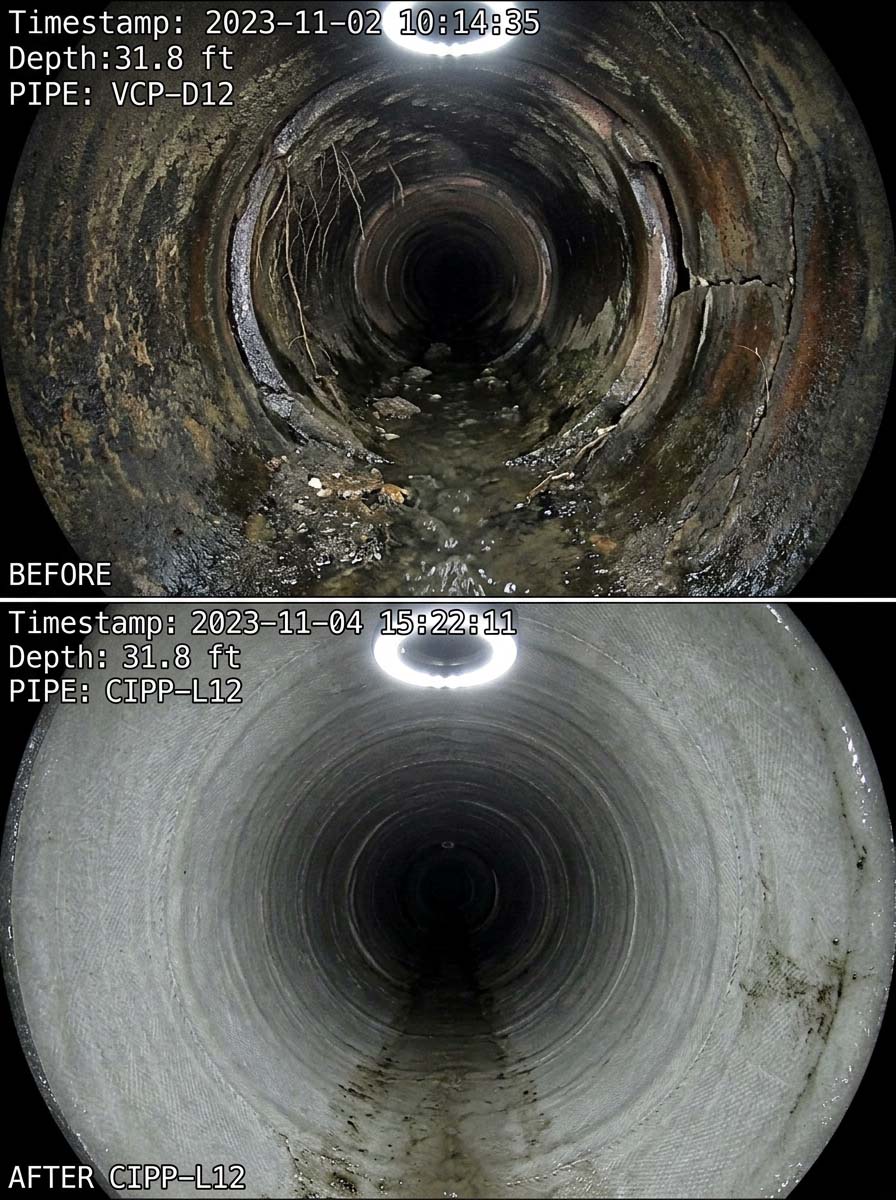
Large diameter pipe lining can be an effective way to rehabilitate a culvert without removing the existing pipe. The liner creates a new interior surface within the host pipe and can improve flow, seal defects, provide corrosion resistance, and extend service life. This is especially valuable when the culvert runs under pavement, roads, parking lots, landscaped areas, driveways, facility access points, or active commercial property.

Aqua Pro Plumbing evaluates lining based on pipe diameter, pipe material, pipe shape, access, defect severity, flow conditions, and site constraints. Lining is not a shortcut. The culvert must be cleaned, measured, inspected, and prepared correctly. If the pipe has severe deformation, active collapse, missing sections, or unsupported voids, additional stabilization or repair may be needed before lining is considered.

Do not let a lining decision happen before the culvert is properly assessed. A liner installed over debris, active soil loss, severe deformation, or unresolved void conditions may not solve the real problem. The lining plan must match the pipe condition and the site conditions. That is why inspection and preparation are part of the repair, not optional steps.

Point Repairs for Localized Culvert Defects

Not every culvert needs full-length rehabilitation. Some culverts have localized defects that can be addressed with targeted repair. These defects may include a separated joint, cracked section, root intrusion point, localized wall loss, small collapse area, or isolated infiltration source.

Point repair can be used when the rest of the culvert remains serviceable and the defect is limited enough to repair directly. This approach can control costs and reduce site disruption while still addressing the failure point. The key is confirming that the defect is actually localized. A single visible problem may be the first sign of a larger hidden issue, especially in older stormwater systems.

Aqua Pro Plumbing uses inspection and defect documentation to determine when point repair makes sense. We focus on repairing the section that is causing the problem while avoiding unnecessary full-length replacement when the pipe does not need it.

Grouting and Stabilization Around Culvert Defects

When water and soil are moving through culvert defects, sealing the pipe opening may not be enough. The surrounding ground may also need stabilization. Grouting can be used in certain situations to help seal infiltration pathways, fill voids, reduce water movement, and support the area around the defect.

This type of repair is important when there are signs of soil migration, sinkhole activity, pavement settlement, shoulder loss, or active infiltration. The goal is to stop the pathway that allows water to carry soil into the culvert. If the soil loss continues, the surface above the culvert can continue to fail even after basic pipe cleaning.

Prevent the ground loss before it reaches the surface. Once a depression appears in pavement or soil, the underground failure has usually been active for some time. Early culvert inspection and sealing can help prevent larger restoration costs.

Hydraulic Capacity and Drainage Performance

A culvert rehabilitation project must protect hydraulic performance. The repaired pipe must still move stormwater. That means the repair plan must consider diameter, flow area, slope, downstream restrictions, inlet control, outlet conditions, sediment load, and the effect of any liner or repair material on the final internal diameter.

A culvert with a smooth interior may move water more efficiently than a heavily corroded or sediment-filled pipe. A culvert with sealed joints may reduce turbulence and soil entry. A culvert with restored shape and open flow area may reduce upstream flooding. The final repair should improve reliability, not create a new bottleneck.

In Miami and Fort Lauderdale, hydraulic performance matters because stormwater systems are tested often. Heavy rain can expose every weak point in the system. A restricted culvert can back up catch basins. A failed outlet can wash out an embankment. A partially blocked crossing can flood a road or parking lot. Aqua Pro Plumbing looks at culvert rehabilitation from both a structural and drainage performance standpoint.

Commercial Culvert Repair

Commercial properties cannot afford recurring drainage failures. A failed culvert can affect tenant access, customer parking, delivery routes, loading areas, ADA paths, landscape areas, stormwater ponds, and building perimeter drainage. For property managers and owners, the issue is not only the pipe. It is the disruption that follows when the pipe is ignored.

Aqua Pro Plumbing works on culvert problems for shopping centers, apartment communities, warehouses, office properties, industrial sites, hotels, schools, healthcare properties, and managed facilities. Our repair planning considers access, site operations, safety, staging, water flow, weather exposure, and surface restoration risk.

Do not wait until a parking lot depression turns into a barricaded area. Culvert failures usually become more expensive after the surface begins to move. Early inspection and rehabilitation can help prevent emergency excavation, tenant complaints, stormwater violations, and repeated maintenance calls.

Municipal and Roadway Culvert Rehabilitation

Municipal culverts and roadway crossings need practical repair planning. These systems may run below local roads, neighborhood streets, sidewalks, swales, rights of way, outfalls, and stormwater conveyance routes. When they fail, the result can include road settlement, shoulder erosion, flooding, traffic control needs, and public complaints.

Aqua Pro Plumbing supports culvert rehabilitation for public and private roadway drainage systems in the Miami and Fort Lauderdale area. The work may involve inspection, cleaning, defect identification, flow restoration, joint repair, lining, grouting, and coordination with site stakeholders.

Prevent small roadway drainage issues from becoming emergency road repairs. A culvert that is losing soil at the joints or invert can undermine pavement long before the road surface fails. Once the surface drops, the repair becomes more disruptive and more visible.

Stormwater Culverts Under Parking Lots and Private Roads

Parking lot culverts are often ignored until they create a visible surface problem. The pipe may be out of sight, but it is carrying runoff from large paved areas. That runoff can move quickly during heavy rain and carry sand, sediment, oil residue, leaves, trash, and debris into the drainage system.

If the culvert is restricted, the parking lot may hold water. If the pipe is leaking at joints, the base material under the asphalt may wash into the pipe. If the outlet is blocked or eroded, water may back up through the system. If the invert is deteriorated, the pipe can lose support and begin to deform.

We fix these problems by identifying where the culvert is failing and selecting the right repair method. Cleaning may restore flow. Joint repair may stop soil migration. Lining may rehabilitate a deteriorated barrel. Grouting may help stabilize active water and soil pathways. Partial excavation may be needed when the pipe has collapsed or the surrounding structure is no longer stable.

Why Early Culvert Rehabilitation Saves Money

Early culvert rehabilitation is usually less disruptive than emergency replacement. When a culvert is repaired before the surface fails, the project can often be planned, staged, and completed with less damage to surrounding improvements. Once the culvert causes pavement collapse, washout, or active flooding, the owner may be dealing with excavation, traffic control, emergency drainage, surface restoration, tenant disruption, and liability exposure.

Do not let a culvert problem become a capital emergency. Warning signs should be inspected quickly. These include recurring standing water, sediment at the outlet, rust-colored discharge, soil entering the pipe, cracks in pavement, depressions above the culvert, sinkhole activity, exposed pipe, separated joints, visible corrosion, root intrusion, washed-out headwalls, and drainage complaints after normal rain events.

Aqua Pro Plumbing helps owners make better decisions by locating the actual failure point. Cleaning without inspection can miss structural defects. Patching without stabilization can miss soil loss. Replacing pipe without understanding downstream restriction can leave the drainage complaint unresolved. Good culvert rehabilitation starts with the cause.

Large Diameter Culvert Rehabilitation in South Florida Conditions

Miami and Fort Lauderdale culvert repair requires attention to South Florida conditions. High groundwater can make excavation more difficult. Heavy rain can interrupt work windows. Coastal conditions can accelerate corrosion. Flat grades can reduce self-cleaning flow velocity. Sediment can collect quickly. Older drainage systems may have limited access points or undocumented pipe routes.

Aqua Pro Plumbing accounts for these conditions during inspection and repair planning. The company looks at access, water level,

View full profile

/sewer-repair-contractors/florida/aqua-pro-plumbing/services/culvert-rehabilitation